RUST语言学习和Rcore实验感想 写在前面 这篇博客可能长度有点长(逃),因为之前没get到要求,以为blog是从二阶段才开始要写hhhh,所以从来没写过就是了hhh~~
这篇blog的主要内容是将我在学习RUST期间所做的笔记做一个整理(主要是来自于RUST语言圣经的节选)以便于自己后续回顾,以及将RUSTLINGS习题集中一些值得标注的语法问题做了记录。
:cry:二阶段得好好写了hhhh
RUST语言圣经笔记 数据类型
数据类型
数值类型: 有符号整数 (i8, i16, i32, i64, isize)、 无符号整数 (u8, u16, u32, u64, usize) 、浮点数 (f32, f64)、以及有理数、复数
Nan表示未被定义的结果
debug模式检查整数溢出,release不会管
浮点数不支持判等(eq操作未实现)
字符串:字符串字面量和字符串切片 &str
布尔类型: true和false,1个字节
字符类型: 表示单个 Unicode 字符 ,存储为 4 个字节
单元类型: 即 () ,其唯一的值也是 ()
一般来说不用显式声明,RUST编译器有变量推导
比较逆天的话就不行了……
1 2 3 4 5 6 7 8 9 let guess = "42" .parse().expect("Not a number!" );let twenty = 20 ;let twenty_one: i32 = 21 ;let twenty_two = 22i32 ;
序列
生成连续值 ,只允许用于数字和字符类型(编译器可在编译期确定类型和判空)
1 2 3 4 5 6 7 for i in 1 ..=5 { println! ("{}" ,i); } for i in 'a' ..='z' { println! ("{}" ,i); }
函数
1 2 3 fn add i32 , j: i32 ) -> i32 { i + j }
特殊返回类型
无返回值
函数没有返回值,那么返回一个 ()
通过 ; 结尾的语句返回一个 ()
发散函数:永不返回
用!作为函数的返回类型
所有权和借用
C和RUST的内存管理差别
1 2 3 4 5 6 7 8 int * foo () int a; a = 100 ; char *c = "xyz" ; return &a; }
所有权规则
Rust 中每一个值都被一个变量所拥有,该变量被称为值的所有者
一个值同时只能被一个变量所拥有,或者说一个值只能拥有一个所有者
当所有者(变量)离开作用域范围时,这个值将被丢弃(drop)
1 2 3 4 5 6 7 8 9 10 11 12 13 14 15 16 let x = 5 ;let y = x;let s1 = String ::from("hello" );let s2 = s1;let s1 = String ::from("hello" );let s2 = s1.clone();let x: &str = "hello, world" ;let y = x;
Copy特征:一个旧的变量在被赋值给其他变量后仍然可用,也就是赋值的过程即是拷贝的过程。任何基本类型的组合可以 Copy ,不需要分配内存或某种形式资源的类型是可以 Copy 的 。
所有整数类型,比如 u32
布尔类型,bool,它的值是 true 和 false
所有浮点数类型,比如 f64
字符类型,char
元组,当且仅当其包含的类型也都是 Copy 的时候。比如,(i32, i32) 是 Copy 的,但 (i32, String) 就不是
不可变引用 &T ,例如转移所有权 中的最后一个例子,但是注意: 可变引用 &mut T 是不可以 Copy的
函数传值和返回——所有权的不断变化
1 2 3 4 5 6 7 8 9 10 11 12 13 14 15 16 17 18 19 20 21 22 23 24 25 fn main let s1 = gives_ownership(); let s2 = String ::from("hello" ); let s3 = takes_and_gives_back(s2); } fn gives_ownership String { let some_string = String ::from("hello" ); some_string } fn takes_and_gives_back String ) -> String { a_string }
引用
1 2 3 4 5 6 7 8 9 10 11 12 13 14 15 16 17 18 19 20 21 22 23 24 25 26 27 28 29 30 31 32 33 34 35 36 37 38 39 40 41 42 43 fn main let s1 = String ::from("hello" ); let len = calculate_length(&s1); println! ("The length of '{}' is {}." , s1, len); } fn calculate_length String ) -> usize { s.len() } ———————————————— fn main let mut s = String ::from("hello" ); change(&mut s); } fn change mut String ) { some_string.push_str(", world" ); } ———————————————— let mut s = String ::from("hello" );let r1 = &mut s;let r2 = &mut s;println! ("{}, {}" , r1, r2);———————————————— let mut s = String ::from("hello" );let r1 = &s; let r2 = &s; let r3 = &mut s; println! ("{}, {}, and {}" , r1, r2, r3);
引用的作用域 s 从创建开始,一直持续到它最后一次使用的地方,这个跟变量的作用域有所不同,变量的作用域从创建持续到某一个花括号结束。
1 2 3 4 5 6 7 8 9 10 11 12 13 fn main let mut s = String ::from("hello" ); let r1 = &s; let r2 = &s; println! ("{} and {}" , r1, r2); let r3 = &mut s; println! ("{}" , r3); }
悬垂引用在Rust是不会存在的,因为当你获取数据的引用后,编译器可以确保数据不会在引用结束前被释放,要想释放数据,必须先停止其引用的使用 。
1 2 3 4 5 6 7 8 9 10 fn main let reference_to_nothing = dangle(); } fn dangle String { let s = String ::from("hello" ); &s }
复合类型 字符串和切片
Rust 中的字符是 Unicode 类型,因此每个字符占据 4 个字节内存空间,但是在字符串中不一样,字符串是 UTF-8 编码,也就是字符串中的字符所占的字节数是变化的(1 - 4) 。
为啥 String 可变,而字符串字面值 str 却不可以?
就字符串字面值来说,我们在编译时就知道其内容,最终字面值文本被直接硬编码进可执行文件中,这使得字符串字面值快速且高效,这主要得益于字符串字面值的不可变性。不幸的是,我们不能为了获得这种性能,而把每一个在编译时大小未知的文本都放进内存中(你也做不到!),因为有的字符串是在程序运行的过程中动态生成的。
String和&str的转换
1 2 3 4 5 6 7 8 9 10 11 12 13 14 15 String ::from("hello,world" )"hello,world" .to_string()fn main let s = String ::from("hello,world!" ); say_hello(&s); say_hello(&s[..]); say_hello(s.as_str()); } fn say_hello str ) { println! ("{}" ,s); }
字符串索引(Rust不支持 )
1 2 3 4 5 let s1 = String ::from("hello" );let hello = String ::from("中国人" );let h = s1[0 ];let h = hello[0 ];
还有一个原因导致了 Rust 不允许去索引字符串:因为索引操作,我们总是期望它的性能表现是 O(1),然而对于 String 类型来说,无法保证这一点,因为 Rust 可能需要从 0 开始去遍历字符串来定位合法的字符。
字符串的区间切片Rust是支持 的,但是必须谨慎
1 2 let hello = "中国人" ;let s = &hello[0 ..2 ];
常见字符串操作
追加和插入
1 2 3 4 5 6 7 8 9 10 11 12 13 14 15 fn main let mut s = String ::from("Hello " ); s.push_str("rust" ); s.push('!' ); } fn main let mut s = String ::from("Hello rust!" ); s.insert(5 , ',' ); s.insert_str(6 , " I like" ); }
替换
1 2 3 4 5 6 7 8 9 10 11 12 13 14 15 16 17 18 19 20 fn main let string_replace = String ::from("I like rust. Learning rust is my favorite!" ); let new_string_replace = string_replace.replace("rust" , "RUST" ); } fn main let string_replace = "I like rust. Learning rust is my favorite!" ; let new_string_replacen = string_replace.replacen("rust" , "RUST" , 1 ); dbg!(new_string_replacen); } fn main let mut string_replace_range = String ::from("I like rust!" ); string_replace_range.replace_range(7 ..8 , "R" ); }
删除
1 2 3 4 5 6 7 8 9 10 11 12 13 14 15 16 17 18 19 20 21 22 23 24 25 26 27 28 29 30 31 32 33 34 35 36 fn main let mut string_pop = String ::from("rust pop 中文!" ); let p1 = string_pop.pop(); let p2 = string_pop.pop(); } fn main let mut string_remove = String ::from("测试remove方法" ); println! ( "string_remove 占 {} 个字节" , std::mem::size_of_val(string_remove.as_str()) ); string_remove.remove(0 ); dbg!(string_remove); } fn main let mut string_truncate = String ::from("测试truncate" ); string_truncate.truncate(3 ); } fn main let mut string_clear = String ::from("string clear" ); string_clear.clear(); dbg!(string_clear); }
连接
1 2 3 4 5 6 7 8 9 10 11 12 13 14 15 16 17 18 19 20 fn main let string_append = String ::from("hello " ); let string_rust = String ::from("rust" ); let result = string_append + &string_rust; let mut result = result + "!" ; result += "!!!" ; println! ("连接字符串 + -> {}" , result); } fn main let s1 = "hello" ; let s2 = String ::from("rust" ); let s = format! ("{} {}!" , s1, s2); println! ("{}" , s); }
元组 1 2 3 4 5 6 7 8 9 10 11 12 13 14 15 16 17 18 19 fn main let tup = (500 , 6.4 , 1 ); let (x, y, z) = tup; println! ("The value of y is: {}" , y); } fn main let x: (i32 , f64 , u8 ) = (500 , 6.4 , 1 ); let five_hundred = x.0 ; let six_point_four = x.1 ; let one = x.2 ; }
结构体
结构体语法
1 2 3 4 5 6 7 8 9 10 11 12 13 14 15 16 17 18 19 20 21 22 23 24 25 26 27 28 29 30 31 32 33 34 35 36 37 38 39 40 41 42 43 44 45 46 47 48 49 50 51 52 53 54 55 56 57 58 struct User active: bool , username: String , email: String , sign_in_count: u64 , } let user1 = User { email: String ::from("someone@example.com" ), username: String ::from("someusername123" ), active: true , sign_in_count: 1 , }; let mut user1 = User { email: String ::from("someone@example.com" ), username: String ::from("someusername123" ), active: true , sign_in_count: 1 , }; user1.email = String ::from("anotheremail@example.com" ); fn build_user String , username: String ) -> User { User { email, username, active: true , sign_in_count: 1 , } } let user2 = User { email: String ::from("another@example.com" ), ..user1 }; let user1 = User { email: String ::from("someone@example.com" ), username: String ::from("someusername123" ), active: true , sign_in_count: 1 , }; let user2 = User { active: user1.active, username: user1.username, email: String ::from("another@example.com" ), sign_in_count: user1.sign_in_count, }; println! ("{}" , user1.active);println! ("{:?}" , user1);
元组结构体
为整个结构体提供名称,而字段不需要
1 2 3 4 5 struct Color i32 , i32 , i32 );struct Point i32 , i32 , i32 );let black = Color(0 , 0 , 0 );let origin = Point(0 , 0 , 0 );
单元结构体:没有任何字段和属性的结构体
枚举
任何数据类型都可以放到枚举中
1 2 3 4 5 6 7 8 9 10 11 enum PokerCard Clubs(u8 ), Spades(u8 ), Diamonds(char ), Hearts(char ), } fn main let c1 = PokerCard::Spades(5 ); let c2 = PokerCard::Diamonds('A' ); }
枚举和结构体的对比
1 2 3 4 5 6 7 8 9 10 11 12 13 14 15 16 17 18 19 20 21 22 23 24 enum Message Quit, Move { x: i32 , y: i32 }, Write(String ), ChangeColor(i32 , i32 , i32 ), } fn main let m1 = Message::Quit; let m2 = Message::Move{x:1 ,y:1 }; let m3 = Message::ChangeColor(255 ,255 ,0 ); } struct QuitMessage struct MoveMessage x: i32 , y: i32 , } struct WriteMessage String ); struct ChangeColorMessage i32 , i32 , i32 );
取代NULL的方式——Option()枚举
1 2 3 4 5 6 7 8 9 10 11 12 13 14 enum Option Some (T), None , } —————————————— let some_number = Some (5 );let some_string = Some ("a string" );let absent_number: Option <i32 > = None ;
Option()枚举的好处
1 2 3 4 let x: i8 = 5 ;let y: Option <i8 > = Some (5 );let sum = x + y;
当在 Rust 中拥有一个像 i8 这样类型的值时,编译器确保它总是有一个有效的值,我们可以放心使用而无需做空值检查。只有当使用 Option<i8>(或者任何用到的类型)的时候才需要担心可能没有值,而编译器会确保我们在使用值之前处理了为空的情况。
换句话说,在对 Option<T> 进行 T 的运算之前必须将其转换为 T。通常这能帮助我们捕获到空值最常见的问题之一:期望某值不为空但实际上为空的情况。
match表达式可以用于处理枚举
1 2 3 4 5 6 7 8 9 10 fn plus_one Option <i32 >) -> Option <i32 > { match x { None => None , Some (i) => Some (i + 1 ), } } let five = Some (5 );let six = plus_one(five);let none = plus_one(None );
数组
创建
1 2 3 4 5 6 7 8 9 10 11 12 13 14 15 16 17 18 let a: [i32 ; 5 ] = [1 , 2 , 3 , 4 , 5 ];let a = [3 ; 5 ];let array = [String ::from("rust is good!" ); 8 ];let array = [String ::from("rust is good!" ),String ::from("rust is good!" ),String ::from("rust is good!" )];let array: [String ; 8 ] = std::array::from_fn(|_i| String ::from("rust is good!" ));
支持索引访问,如果越界会崩溃
流程控制 1 2 3 4 5 6 7 8 9 10 11 12 13 14 fn main for i in 1 ..=5 { println! ("{}" , i); } } fn main let a = [4 , 3 , 2 , 1 ]; for (i, v) in a.iter().enumerate() { println! ("第{}个元素是{}" , i + 1 , v); } }
使用方法
等价使用方式
所有权
for item in collectionfor item in IntoIterator::into_iter(collection)转移所有权
for item in &collectionfor item in collection.iter()不可变借用
for item in &mut collectionfor item in collection.iter_mut()可变借用
1 2 3 4 5 6 7 8 9 10 11 12 13 14 15 16 17 18 19 20 21 22 23 24 let collection = [1 , 2 , 3 , 4 , 5 ];for i in 0 ..collection.len() { let item = collection[i]; } for item in collection {} fn main let a = [10 , 20 , 30 , 40 , 50 ]; let mut index = 0 ; while index < 5 { println! ("the value is: {}" , a[index]); index = index + 1 ; } }
第一种方式是循环索引,然后通过索引下标去访问集合,第二种方式是直接循环集合中的元素,优劣如下:
性能 :第一种使用方式中 collection[index] 的索引访问,会因为边界检查(Bounds Checking)导致运行时的性能损耗 —— Rust 会检查并确认 index 是否落在集合内,但是第二种直接迭代的方式就不会触发这种检查,因为编译器会在编译时就完成分析并证明这种访问是合法的安全 :第一种方式里对 collection 的索引访问是非连续的,存在一定可能性在两次访问之间,collection 发生了变化,导致脏数据产生。而第二种直接迭代的方式是连续访问,因此不存在这种风险( 由于所有权限制,在访问过程中,数据并不会发生变化)。
loop:简单的无限循环,需要搭配break跳出
1 2 3 4 5 6 7 8 9 10 11 12 13 fn main let mut counter = 0 ; let result = loop { counter += 1 ; if counter == 10 { break counter * 2 ; } }; println! ("The result is {}" , result); }
模式匹配 match和if let
匹配
1 2 3 4 5 6 7 8 9 10 11 12 13 14 15 16 17 18 19 20 enum Coin Penny, Nickel, Dime, Quarter, } fn value_in_cents u8 { match coin { Coin::Penny => { println! ("Lucky penny!" ); 1 }, Coin::Nickel => 5 , Coin::Dime => 10 , Coin::Quarter => 25 , } }
模式绑定
1 2 3 4 5 6 7 8 9 10 11 12 13 14 15 16 17 18 19 20 21 22 23 24 25 #[derive(Debug)] enum UsState Alabama, Alaska, } enum Coin Penny, Nickel, Dime, Quarter(UsState), } fn value_in_cents u8 { match coin { Coin::Penny => 1 , Coin::Nickel => 5 , Coin::Dime => 10 , Coin::Quarter(state) => { println! ("State quarter from {:?}!" , state); 25 }, } }
if let匹配
当我们只关注某个特定的值的匹配情况时,可以使用if let匹配代替match
1 2 3 4 5 6 7 8 9 10 let v = Some (3u8 );match v { Some (3 ) => println! ("three" ), _ => (), } if let Some (3 ) = v { println! ("three" ); }
matches!()宏
将表达式和模式进行匹配,返回True或者False
1 2 3 4 5 6 7 8 9 10 11 12 13 14 15 16 17 enum MyEnum Foo, Bar } fn main let v = vec! [MyEnum::Foo,MyEnum::Bar,MyEnum::Foo]; } v.iter().filter(|x| matches!(x, MyEnum::Foo)); let foo = 'f' ;assert! (matches!(foo, 'A' ..='Z' | 'a' ..='z' ));let bar = Some (4 );assert! (matches!(bar, Some (x) if x > 2 ));
match和if let匹配导致的变量遮蔽
尽量不要使用同名变量
1 2 3 4 5 6 7 8 9 10 11 12 13 14 15 16 17 18 19 fn main let age = Some (30 ); println! ("在匹配前,age是{:?}" ,age); if let Some (age) = age { println! ("匹配出来的age是{}" ,age); } println! ("在匹配后,age是{:?}" ,age); } fn main let age = Some (30 ); println! ("在匹配前,age是{:?}" ,age); match age { Some (age) => println! ("匹配出来的age是{}" ,age), _ => () } println! ("在匹配后,age是{:?}" ,age); }
一些模式适用场景
while let 只要匹配就会一直循环下去
1 2 3 4 5 6 7 8 9 10 11 12 let mut stack = Vec ::new();stack.push(1 ); stack.push(2 ); stack.push(3 ); while let Some (top) = stack.pop() { println! ("{}" , top); }
let和if let
1 2 3 4 5 6 let Some (x) = some_option_value;if let Some (x) = some_option_value { println! ("{}" , x); }
全模式列表
用序列语法..=匹配区间内的值(还是只能用于数字和字符)
1 2 3 4 5 6 let x = 5 ;match x { 1 ..=5 => println! ("one through five" ), _ => println! ("something else" ), }
使用模式忽略值
1 2 3 4 5 6 7 8 fn foo i32 , y: i32 ) { println! ("This code only uses the y parameter: {}" , y); } fn main foo(3 , 4 ); }
用_忽略值和用_s的区别
1 2 3 4 5 6 7 8 9 10 11 12 13 14 15 16 17 let s = Some (String ::from("Hello!" ));if let Some (_s) = s { println! ("found a string" ); } println! ("{:?}" , s);—————————————————————————— let s = Some (String ::from("Hello!" ));if let Some (_) = s { println! ("found a string" ); } println! ("{:?}" , s);
使用..忽略多个值需要保证没有歧义
1 2 3 4 5 6 7 8 9 fn main let numbers = (2 , 4 , 8 , 16 , 32 ); match numbers { (.., second, ..) => { println! ("Some numbers: {}" , second) }, } }
匹配守卫——为匹配提供额外条件
1 2 3 4 5 6 7 8 9 10 11 12 13 14 15 16 17 18 19 20 21 22 23 fn main let x = Some (5 ); let y = 10 ; match x { Some (50 ) => println! ("Got 50" ), Some (n) if n == y => println! ("Matched, n = {}" , n), _ => println! ("Default case, x = {:?}" , x), } println! ("at the end: x = {:?}, y = {}" , x, y); } —————————————————— let x = 4 ;let y = false ;match x { 4 | 5 | 6 if y => println! ("yes" ), _ => println! ("no" ), }
@绑定——提供在限定范围条件下,在分支代码内部使用变量的能力
1 2 3 4 5 6 7 8 9 10 11 12 13 14 15 16 17 18 19 20 21 22 23 24 25 26 27 28 29 30 31 32 33 34 35 36 37 38 39 40 enum Message Hello { id: i32 }, } let msg = Message::Hello { id: 5 };match msg { Message::Hello { id: id_variable @ 3 ..=7 } => { println! ("Found an id in range: {}" , id_variable) }, Message::Hello { id: 10 ..=12 } => { println! ("Found an id in another range" ) }, Message::Hello { id } => { println! ("Found some other id: {}" , id) }, } ———————————————— #[derive(Debug)] struct Point x: i32 , y: i32 , } fn main let p @ Point {x: px, y: py } = Point {x: 10 , y: 23 }; println! ("x: {}, y: {}" , px, py); println! ("{:?}" , p); let point = Point {x: 10 , y: 5 }; if let p @ Point {x: 10 , y} = point { println! ("x is 10 and y is {} in {:?}" , y, p); } else { println! ("x was not 10 :(" ); } }
方法Method
定义和初始化
1 2 3 4 5 6 7 8 9 10 11 12 13 14 15 16 17 18 19 20 21 22 struct Circle x: f64 , y: f64 , radius: f64 , } impl Circle { fn new f64 , y: f64 , radius: f64 ) -> Circle { Circle { x: x, y: y, radius: radius, } } fn area self ) -> f64 { std::f64 ::consts::PI * (self .radius * self .radius) } }
这种定义在 impl 中且没有 self 的函数被称之为关联函数 : 因为它没有 self,不能用 f.read() 的形式调用,因此它是一个函数而不是方法,它又在 impl 中,与结构体紧密关联,因此称为关联函数。
因为是函数,所以不能用 . 的方式来调用,我们需要用 :: 来调用,例如 let sq = Rectangle::new(3, 3);。这个方法位于结构体的命名空间中::: 语法用于关联函数和模块创建的命名空间。
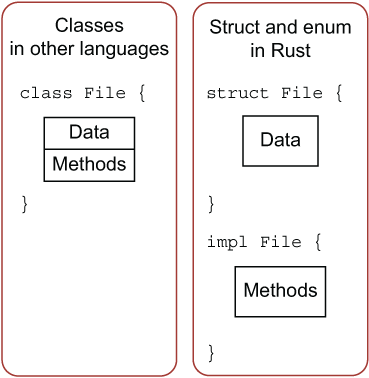
其他的语言往往将类型和方法一起定义,而Rust对这两者的定义是分开的。
self和被实例化类型的关系
1 2 3 4 5 6 7 8 9 10 11 12 13 14 15 16 17 18 19 20 21 22 23 24 #[derive(Debug)] struct Rectangle width: u32 , height: u32 , } impl Rectangle { fn area self ) -> u32 { self .width * self .height } } fn main let rect1 = Rectangle { width: 30 , height: 50 }; println! ( "The area of the rectangle is {} square pixels." , rect1.area() ); }
方法和字段同名的好处
1 2 3 4 5 6 7 8 9 10 11 12 13 14 15 16 17 18 19 pub struct Rectangle width: u32 , height: u32 , } impl Rectangle { pub fn new u32 , height: u32 ) -> Self { Rectangle { width, height } } pub fn width self ) -> u32 { return self .width; } } fn main let rect1 = Rectangle::new(30 , 50 ); println! ("{}" , rect1.width()); }
方法和字段同名有助于我们实现访问器,我们可以将width和height设置为私有属性,而通过pub关键字将Rectangle结构体对应的new方法和width方法设置为公有方法,这样子用户可以通过rect1.width()方法访问到宽度的数据,却无法直接使用rect1.width来访问。
Rust中用自动引用/解引用机制代替了C/C++的->运算符
在 C/C++ 语言中,有两个不同的运算符来调用方法:. 直接在对象上调用方法,而 -> 在一个对象的指针上调用方法,这时需要先解引用指针。换句话说,如果 object 是一个指针,那么 object->something() 和 (*object).something() 是一样的。
Rust 并没有一个与 -> 等效的运算符;相反,Rust 有一个叫 自动引用和解引用 的功能。方法调用是 Rust 中少数几个拥有这种行为的地方。
他是这样工作的:当使用 object.something() 调用方法时,Rust 会自动为 object 添加 &、&mut 或 * 以便使 object 与方法签名匹配。也就是说,这些代码是等价的:
1 2 p1.distance(&p2); (&p1).distance(&p2);
第一行看起来简洁的多。这种自动引用的行为之所以有效,是因为方法有一个明确的接收者———— self 的类型。在给出接收者和方法名的前提下,Rust 可以明确地计算出方法是仅仅读取(&self),做出修改(&mut self)或者是获取所有权(self)。事实上,Rust 对方法接收者的隐式借用让所有权在实践中更友好。
泛型和特征 泛型
代替值的泛型,而不是针对类型的泛型
1 2 3 4 5 6 7 8 9 10 11 12 13 14 15 16 17 18 19 20 21 22 23 24 25 26 27 28 29 30 31 32 33 34 35 fn display_array i32 ; 3 ]) { println! ("{:?}" , arr); } fn main let arr: [i32 ; 3 ] = [1 , 2 , 3 ]; display_array(arr); let arr: [i32 ; 2 ] = [1 , 2 ]; display_array(arr); } fn display_array Debug >(arr: &[T]) { println! ("{:?}" , arr); } fn main let arr: [i32 ; 3 ] = [1 , 2 , 3 ]; display_array(&arr); let arr: [i32 ; 2 ] = [1 , 2 ]; display_array(&arr); } fn display_array Debug , const N: usize >(arr: [T; N]) { println! ("{:?}" , arr); } fn main let arr: [i32 ; 3 ] = [1 , 2 , 3 ]; display_array(arr); let arr: [i32 ; 2 ] = [1 , 2 ]; display_array(arr); }
泛型的性能
编译器完成单态化 的过程,增加了编译的繁琐程度,也让编译后的文件更大
会对每一个具体用到的类型都生成一份代码
1 2 3 4 5 6 7 8 9 10 11 12 13 14 15 16 17 18 19 let integer = Some (5 );let float = Some (5.0 );enum Option_i32 Some (i32 ), None , } enum Option_f64 Some (f64 ), None , } fn main let integer = Option_i32::Some (5 ); let float = Option_f64::Some (5.0 ); }
特征 一组可以被共享的行为,只要满足了特征,就可以做以下的行为。
定义特征
只管定义,而往往不会提供具体的实现
谁满足这个特征,谁来实现具体的方法
1 2 3 4 5 6 7 8 9 pub trait Summary fn summarize self ) -> String ; } pub trait Summary fn summarize self ) -> String { String ::from("(Read more...)" ) } }
默认实现允许调用相同特征中的其他方法,哪怕这些方法没有默认实现。 如此,特征可以提供很多有用的功能而只需要实现指定的一小部分内容。例如,我们可以定义 Summary 特征,使其具有一个需要实现的 summarize_author 方法,然后定义一个 summarize 方法,此方法的默认实现调用 summarize_author 方法:
1 2 3 4 5 6 7 pub trait Summary fn summarize_author self ) -> String ; fn summarize self ) -> String { format! ("(Read more from {}...)" , self .summarize_author()) } }
实现特征
1 2 3 4 5 6 7 8 9 10 11 12 13 14 15 16 17 18 19 20 21 22 23 24 25 pub trait Summary fn summarize self ) -> String ; } pub struct Post pub title: String , pub author: String , pub content: String , } impl Summary for Post { fn summarize self ) -> String { format! ("文章{}, 作者是{}" , self .title, self .author) } } pub struct Weibo pub username: String , pub content: String } impl Summary for Weibo { fn summarize self ) -> String { format! ("{}发表了微博{}" , self .username, self .content) } }
孤儿规则——特征定义和实现的位置关系
关于特征实现与定义的位置,有一条非常重要的原则:如果你想要为类型 A 实现特征 T,那么 A 或者 T 至少有一个是在当前作用域中定义的! 例如我们可以为上面的 Post 类型实现标准库中的 Display 特征,这是因为 Post 类型定义在当前的作用域中。同时,我们也可以在当前包中为 String 类型实现 Summary 特征,因为 Summary 定义在当前作用域中。
但是你无法在当前作用域中,为 String 类型实现 Display 特征,因为它们俩都定义在标准库中,其定义所在的位置都不在当前作用域,跟你半毛钱关系都没有,看看就行了。
使用特征作为函数的参数
1 2 3 pub fn notify impl Summary) { println! ("Breaking news! {}" , item.summarize()); }
特征约束
1 2 3 4 5 6 7 8 9 10 11 12 13 14 15 16 pub fn notify impl Summary, item2: &impl Summary) {}pub fn notify pub fn notify fn some_function i32 where T: Display + Clone , U: Clone + Debug {}
函数返回值中的impl Trait
1 2 3 4 5 6 7 8 9 fn returns_summarizable impl Summary { Weibo { username: String ::from("sunface" ), content: String ::from( "m1 max太厉害了,电脑再也不会卡" , ) } }
这种 impl Trait 形式的返回值,在一种场景下非常非常有用,那就是返回的真实类型非常复杂,你不知道该怎么声明时(毕竟 Rust 要求你必须标出所有的类型),此时就可以用 impl Trait 的方式简单返回。
derive派生特征
在本书中,形如 #[derive(Debug)] 的代码已经出现了很多次,这种是一种特征派生语法,被 derive 标记的对象会自动实现对应的默认特征代码,继承相应的功能。
例如 Debug 特征,它有一套自动实现的默认代码,当你给一个结构体标记后,就可以使用 println!("{:?}", s) 的形式打印该结构体的对象。
再如 Copy 特征,它也有一套自动实现的默认代码,当标记到一个类型上时,可以让这个类型自动实现 Copy 特征,进而可以调用 copy 方法,进行自我复制。
总之,derive 派生出来的是 Rust 默认给我们提供的特征,在开发过程中极大的简化了自己手动实现相应特征的需求,当然,如果你有特殊的需求,还可以自己手动重载该实现。
特征对象 指向了所有实现了某特征的对象,二者之间存在映射关系,可以通过特征对象找到该对象具体的实现方法。
可以通过 & 引用或者 Box<T> 智能指针的方式来创建特征对象
1 2 3 4 5 6 7 8 9 10 11 12 13 14 15 16 17 18 19 20 21 22 23 24 25 26 27 28 29 30 31 32 33 34 35 36 37 38 39 trait Draw fn draw self ) -> String ; } impl Draw for u8 { fn draw self ) -> String { format! ("u8: {}" , *self ) } } impl Draw for f64 { fn draw self ) -> String { format! ("f64: {}" , *self ) } } fn draw1 Box <dyn Draw>) { x.draw(); } fn draw2 dyn Draw) { x.draw(); } fn main let x = 1.1f64 ; let y = 8u8 ; draw1(Box ::new(x)); draw1(Box ::new(y)); draw2(&x); draw2(&y); }
draw1 函数的参数是 Box<dyn Draw> 形式的特征对象,该特征对象是通过 Box::new(x) 的方式创建的draw2 函数的参数是 &dyn Draw 形式的特征对象,该特征对象是通过 &x 的方式创建的dyn 关键字只用在特征对象的类型声明上,在创建时无需使用 dyn
可以通过特征对象来代表具体的泛型。
使用泛型的实现和特征对象的对比
1 2 3 4 5 6 7 8 9 10 11 12 pub struct Screen pub components: Vec <T>, } impl <T> Screen<T> where T: Draw { pub fn run self ) { for component in self .components.iter() { component.draw(); } } }
上面的 Screen 的列表中,存储了类型为 T 的元素,然后在 Screen 中使用特征约束让 T 实现了 Draw 特征,进而可以调用 draw 方法。
但是这种写法限制了 Screen 实例的 Vec<T> 中的每个元素必须是 Button 类型或者全是 SelectBox 类型。如果只需要同质(相同类型)集合,更倾向于采用泛型+特征约束这种写法,因其实现更清晰,且性能更好(特征对象,需要在运行时从 vtable 动态查找需要调用的方法)。
特征对象的限制
不是所有特征都能拥有特征对象,只有对象安全的特征才行。 当一个特征的所有方法都有如下属性时,它的对象才是安全的:
方法的返回类型不能是 Self
方法没有任何泛型参数
对象安全对于特征对象是必须的,因为一旦有了特征对象,就不再需要知道实现该特征的具体类型是什么了。如果特征方法返回了具体的 Self 类型,但是特征对象忘记了其真正的类型,那这个 Self 就非常尴尬,因为没人知道它是谁了。但是对于泛型类型参数来说,当使用特征时其会放入具体的类型参数:此具体类型变成了实现该特征的类型的一部分。而当使用特征对象时其具体类型被抹去了,故而无从得知放入泛型参数类型到底是什么。
标准库中的 Clone 特征就不符合对象安全的要求:
1 2 3 pub trait Clone fn clone self ) -> Self ; }
因为它的其中一个方法,返回了 Self 类型,因此它是对象不安全的。
特征对象的动态分发
静态分发:编译器会为每一个泛型参数对应的具体类型生成一份代码
动态分发:直到运行时,才能确定需要调用什么方法。编译器无法知晓所有可能用于特征对象代码的类型,所以它也不知道应该调用哪个类型的哪个方法实现。
特征对象大小不固定 :这是因为,对于特征 Draw,类型 Button 可以实现特征 Draw,类型 SelectBox 也可以实现特征 Draw,因此特征没有固定大小几乎总是使用特征对象的引用方式,如&dyn Draw和Box<dyn Draw>
虽然特征对象没有固定大小,但它的引用类型的大小是固定的,它由两个指针组成(ptr 和 vptr),因此占用两个指针大小
一个指针 ptr 指向实现了特征 Draw 的具体类型的实例,也就是当作特征 Draw 来用的类型的实例,比如类型 Button 的实例、类型 SelectBox 的实例
另一个指针 vptr 指向一个虚表 vtable,vtable 中保存了类型 Button 或类型 SelectBox 的实例对于可以调用的实现于特征 Draw 的方法。当调用方法时,直接从 vtable 中找到方法并调用。之所以要使用一个 vtable 来保存各实例的方法,是因为实现了特征 Draw 的类型有多种,这些类型拥有的方法各不相同,当将这些类型的实例都当作特征 Draw 来使用时(此时,它们全都看作是特征 Draw 类型的实例),有必要区分这些实例各自有哪些方法可调用
简而言之,当类型 Button 实现了特征 Draw 时,类型 Button 的实例对象 btn 可以当作特征 Draw 的特征对象类型来使用,btn 中保存了作为特征对象的数据指针(指向类型 Button 的实例数据)和行为指针(指向 vtable)。
一定要注意,此时的 btn 是 Draw 的特征对象的实例,而不再是具体类型 Button 的实例,而且 btn 的 vtable 只包含了实现自特征 Draw 的那些方法(比如 draw),因此 btn 只能调用实现于特征 Draw 的 draw 方法,而不能调用类型 Button 本身实现的方法和类型 Button 实现于其他特征的方法。也就是说,btn 是哪个特征对象的实例,它的 vtable 中就包含了该特征的方法。
特征进阶内容
关联类型
在特征定义的语句块中,声明一个自定义类型,这样就可以在特征中使用这个类型。
1 2 3 4 5 pub trait Iterator type Item fn next mut self ) -> Option <Self::Item>; }
Rustlings习题整理 map()的用法 1 2 3 4 5 6 7 8 fn vec_map Vec <i32 >) -> Vec <i32 > { v.iter().map(|element| { *element * 2 }).collect() }
字符串和切片操作 1 2 3 4 5 6 7 8 9 10 11 12 13 14 15 16 17 18 19 20 21 22 23 24 25 26 27 28 29 30 31 32 33 34 35 36 37 38 fn trim_me str ) -> String { input.trim().to_string() } fn compose_me str ) -> String { input.to_string() + " world!" } fn replace_me str ) -> String { input.replace("cars" ,"balloons" ).to_string() } #[cfg(test)] mod tests { use super::*; #[test] fn trim_a_string assert_eq! (trim_me("Hello! " ), "Hello!" ); assert_eq! (trim_me(" What's up!" ), "What's up!" ); assert_eq! (trim_me(" Hola! " ), "Hola!" ); } #[test] fn compose_a_string assert_eq! (compose_me("Hello" ), "Hello world!" ); assert_eq! (compose_me("Goodbye" ), "Goodbye world!" ); } #[test] fn replace_a_string assert_eq! (replace_me("I think cars are cool" ), "I think balloons are cool" ); assert_eq! (replace_me("I love to look at cars" ), "I love to look at balloons" ); } }
判断字符串和字符串切片的类型 1 2 3 4 5 6 7 8 9 10 11 12 13 14 15 16 17 18 19 20 21 22 fn string_slice str ) { println! ("{}" , arg); } fn string String ) { println! ("{}" , arg); } fn main string_slice("blue" ); string("red" .to_string()); string(String ::from("hi" )); string("rust is fun!" .to_owned()); string_slice("nice weather" .into()); string(format! ("Interpolation {}" , "Station" )); string_slice(&String ::from("abc" )[0 ..1 ]); string_slice(" hello there " .trim()); string("Happy Monday!" .to_string().replace("Mon" , "Tues" )); string("mY sHiFt KeY iS sTiCkY" .to_lowercase()); }
clone()
to_owned()
T
T -> T
T -> T
&T
&T -> &T
&T -> T
模块use 1 2 3 4 5 6 7 8 9 10 11 12 13 14 15 16 17 18 19 20 21 22 23 mod delicious_snacks { pub use self::fruits::PEAR as fruit; pub use self::veggies::CUCUMBER as veggie; mod fruits { pub const PEAR: &'static str = "Pear" ; pub const APPLE: &'static str = "Apple" ; } mod veggies { pub const CUCUMBER: &'static str = "Cucumber" ; pub const CARROT: &'static str = "Carrot" ; } } fn main println! ( "favorite snacks: {} and {}" , delicious_snacks::fruit, delicious_snacks::veggie ); }
比赛统计 1 2 3 4 5 6 7 8 9 10 11 12 13 14 15 16 17 18 19 20 21 22 23 24 25 26 27 28 29 30 31 32 33 34 35 36 37 38 39 40 41 42 43 44 45 46 47 48 49 50 51 52 53 54 55 56 57 58 59 60 61 62 63 64 65 66 67 68 69 70 71 72 73 74 75 76 77 use std::collections::HashMap;struct Team goals_scored: u8 , goals_conceded: u8 , } fn build_scores_table String ) -> HashMap<String , Team> { let mut scores: HashMap<String , Team> = HashMap::new(); for r in results.lines() { let v: Vec <&str > = r.split(',' ).collect(); let team_1_name = v[0 ].to_string(); let team_1_score: u8 = v[2 ].parse().unwrap(); let team_2_name = v[1 ].to_string(); let team_2_score: u8 = v[3 ].parse().unwrap(); let team1 = scores.entry(team_1_name).or_insert(Team{ goals_scored:0 , goals_conceded:0 }); team1.goals_scored += team_1_score; team1.goals_conceded += team_2_score; let team2 = scores.entry(team_2_name).or_insert(Team{ goals_scored:0 , goals_conceded:0 }); team2.goals_scored += team_2_score; team2.goals_conceded += team_1_score; } scores } #[cfg(test)] mod tests { use super::*; fn get_results String { let results = "" .to_string() + "England,France,4,2\n" + "France,Italy,3,1\n" + "Poland,Spain,2,0\n" + "Germany,England,2,1\n" ; results } #[test] fn build_scores let scores = build_scores_table(get_results()); let mut keys: Vec <&String > = scores.keys().collect(); keys.sort(); assert_eq! ( keys, vec! ["England" , "France" , "Germany" , "Italy" , "Poland" , "Spain" ] ); } #[test] fn validate_team_score_1 let scores = build_scores_table(get_results()); let team = scores.get("England" ).unwrap(); assert_eq! (team.goals_scored, 5 ); assert_eq! (team.goals_conceded, 4 ); } #[test] fn validate_team_score_2 let scores = build_scores_table(get_results()); let team = scores.get("Spain" ).unwrap(); assert_eq! (team.goals_scored, 0 ); assert_eq! (team.goals_conceded, 2 ); } }
quiz2 首先要观察代码判断其类型,随后用match表达式匹配枚举类型,做出相应的处理
1 2 3 4 5 6 7 8 9 10 11 12 13 14 15 16 17 18 19 20 21 22 23 24 25 26 27 28 29 30 31 32 33 34 35 36 37 38 39 40 41 42 43 44 45 46 pub enum Command Uppercase, Trim, Append(usize ), } mod my_module { use super::Command; pub fn transformer Vec <(String ,Command)>) -> Vec <String > { let mut output: Vec <String > = vec! []; for (string, command) in input.iter() { let applied_string:String = match command{ Command::Uppercase => string.to_uppercase(), Command::Trim => string.trim().to_string(), Command::Append(n) => format! ("{}{}" ,string,"bar" .repeat(*n)), }; output.push(applied_string); } output } } #[cfg(test)] mod tests { use crate::my_module::transformer; use super::Command; #[test] fn it_works let output = transformer(vec! [ ("hello" .into(), Command::Uppercase), (" all roads lead to rome! " .into(), Command::Trim), ("foo" .into(), Command::Append(1 )), ("bar" .into(), Command::Append(5 )), ]); assert_eq! (output[0 ], "HELLO" ); assert_eq! (output[1 ], "all roads lead to rome!" ); assert_eq! (output[2 ], "foobar" ); assert_eq! (output[3 ], "barbarbarbarbarbar" ); } }
从Option中取出值 1 2 3 4 5 6 7 8 9 10 11 12 let my_option: Option <i32 > = Some (5 ); let value = my_option.unwrap();println! ("The value is: {}" , value);let my_option: Option <i32 > = Some (5 ); let value = my_option.unwrap_or(0 ); println! ("The value is: {}" , value);
Option的类型问题 1 2 3 4 5 6 7 8 9 10 11 12 13 14 let range = 10 ;let mut optional_integers: Vec <Option <i8 >> = vec! [None ];for i in 1 ..(range + 1 ) { optional_integers.push(Some (i)); } let mut cursor = range;while let Some (Some (integer)) = optional_integers.pop() { assert_eq! (integer, cursor); cursor -= 1 ; }
所有权的问题 1 2 3 4 5 6 7 8 9 10 11 12 13 14 15 struct Point x: i32 , y: i32 , } fn main let y: Option <Point> = Some (Point { x: 100 , y: 200 }); match y { Some (ref p) => println! ("Co-ordinates are {},{} " , p.x, p.y), _ => panic! ("no match!" ), } y; }
? 表达式 1 2 3 4 5 6 7 8 9 10 11 12 13 14 15 16 impl ParsePosNonzeroError { fn from_creation ParsePosNonzeroError::Creation(err) } fn from_parseint ParsePosNonzeroError::ParseInt(err) } } fn parse_pos_nonzero str ) -> Result <PositiveNonzeroInteger, ParsePosNonzeroError> { let x: i64 = s.parse().map_err(ParsePosNonzeroError::from_parseint)?; PositiveNonzeroInteger::new(x).map_err(ParsePosNonzeroError::from_creation) }
为动态数组Vector实现特征 1 2 3 4 5 6 7 8 9 10 11 12 13 14 15 16 17 18 19 20 21 22 23 trait AppendBar fn append_bar self ) -> Self ; } impl AppendBar for Vec <String >{ fn append_bar mut self ) -> Self { self .push("Bar" .to_string()); self } } #[cfg(test)] mod tests { use super::*; #[test] fn is_vec_pop_eq_bar let mut foo = vec! [String ::from("Foo" )].append_bar(); assert_eq! (foo.pop().unwrap(), String ::from("Bar" )); assert_eq! (foo.pop().unwrap(), String ::from("Foo" )); } }
特征约束代替类型 1 2 3 4 5 6 7 8 9 10 11 12 13 14 15 16 17 18 19 20 21 22 23 24 25 26 27 28 29 30 31 32 33 34 35 36 37 38 39 40 pub trait Licensed fn licensing_info self ) -> String { "some information" .to_string() } } struct SomeSoftware struct OtherSoftware impl Licensed for SomeSoftware {}impl Licensed for OtherSoftware {}fn compare_license_types impl Licensed, software_two:impl Licensed) -> bool { software.licensing_info() == software_two.licensing_info() } #[cfg(test)] mod tests { use super::*; #[test] fn compare_license_information let some_software = SomeSoftware {}; let other_software = OtherSoftware {}; assert! (compare_license_types(some_software, other_software)); } #[test] fn compare_license_information_backwards let some_software = SomeSoftware {}; let other_software = OtherSoftware {}; assert! (compare_license_types(other_software, some_software)); } }
#[should_panic] 1 2 3 4 5 6 7 8 9 10 11 12 13 14 15 16 17 18 19 20 21 22 23 24 25 26 27 28 29 30 31 32 33 34 35 36 37 38 39 40 41 42 struct Rectangle width: i32 , height: i32 } impl Rectangle { pub fn new i32 , height: i32 ) -> Self { if width <= 0 || height <= 0 { panic! ("Rectangle width and height cannot be negative!" ) } Rectangle {width, height} } } #[cfg(test)] mod tests { use super::*; #[test] fn correct_width_and_height let rect = Rectangle::new(10 , 20 ); assert_eq! (rect.width, 10 ); assert_eq! (rect.height, 20 ); } #[test] #[should_panic] fn negative_width let _rect = Rectangle::new(-10 , 10 ); } #[test] #[should_panic] fn negative_height let _rect = Rectangle::new(10 , -10 ); } }
迭代器方法 1 2 3 4 5 6 7 8 9 10 11 12 13 14 15 16 17 18 19 20 21 22 23 24 25 26 27 28 29 30 31 32 33 34 35 36 37 38 39 40 41 42 43 44 45 46 47 48 49 50 51 52 53 54 55 56 57 58 pub fn capitalize_first str ) -> String { let mut c = input.chars(); match c.next() { None => String ::new(), Some (first) => first.to_uppercase().to_string() + c.as_str(), } } pub fn capitalize_words_vector str ]) -> Vec <String > { words.iter().map( |&word| { capitalize_first(word) } ).collect() } pub fn capitalize_words_string str ]) -> String { words.iter().map( |&word| { capitalize_first(word) } ).collect() } #[cfg(test)] mod tests { use super::*; #[test] fn test_success assert_eq! (capitalize_first("hello" ), "Hello" ); } #[test] fn test_empty assert_eq! (capitalize_first("" ), "" ); } #[test] fn test_iterate_string_vec let words = vec! ["hello" , "world" ]; assert_eq! (capitalize_words_vector(&words), ["Hello" , "World" ]); } #[test] fn test_iterate_into_string let words = vec! ["hello" , " " , "world" ]; assert_eq! (capitalize_words_string(&words), "Hello World" ); } }
宏 1 2 3 4 5 6 7 8 9 10 11 12 13 14 15 16 17 18 19 20 21 22 23 24 25 26 macro_rules! my_macro { () => { println! ("Check out my macro!" ); }; } fn main my_macro!(); } #[rustfmt::skip] macro_rules! my_macro { () => { println! ("Check out my macro!" ); }; ($val:expr) => { println! ("Look at this other macro: {}" , $val); } } fn main my_macro!(); my_macro!(7777 ); }
Rcore实验感想 写在前面 由于实验要求不能够贴代码,因此本报告重点就是日记这种了……
会简单的讲一下过程
Lab3 看了一下自己写的东西……玛德我原本也贴了不少代码
行吧……那就放些记录性的东西
……
报错挺多的,反正就照着编译器一个一个来吧……
类型错误……
missing documentations for functions
不写注释也不行 笑
Lab4 重写sys_get_time和sys_task_info 先看看原本的sys_get_time是如何实现的?
对指针*ts所指向的内存空间赋值时间信息,在引入虚存之前应用空间和内核空间之间不存在隔离,二者都可以直接访问到*ts所在位置。在引入虚存之后,每个应用以及内核本身都有独立的地址空间,没办法访问了。
因此我们需要想办法,使得OS能够访问到应用所在的位置,需要完成二者地址的翻译。
……
和mmap那个题目一样,sys_get_time以及sys_task_info也是需要在当前任务下才行
为什么突然写回来了呢……(因为在线CI测了sys_get_time还有sys_task_info 发现自己写的根本就不对
我知道哪里不行了 我的实现没问题 搞得我还重写了一次
每次执行系统调用的时候忘记调用add_syscall_num
mmap insert_frame_area函数是比较值得参考的一个函数
不仅仅是函数实现的功能类似,用法也很值得学习
……
随后就是漫长的调试……
这里注意到特殊的一行
[kernel] PageFault in application, bad addr = {:#x}, bad instruction = {:#x}, kernel killed it.
先找到这行输出是哪里来的,发现在Trap_handler方法里面
然后再考虑,发现其实我的程序连mmap0都没正常跑完
但是正确分配了页面,要不然就不会有start_va:0x10000000~end_va:0x10001000 map_perm:0x16输出
这里的0x16完全没问题(之前看成10进制了)
0001 0110 代表U,W,R被置位 而测试用例mmap0给的是3 也就是011 也是对应W,R
妈的 我知道怎么搞了 之所以会不断出现The Page you wanted has been alloced to others的报错信息是因为之前在sys_mmap方法中对MemorySet中mmap()的调用是这样子的
1 2 3 let num = KERNEL_SPACE.exclusive_access().mmap(start, len, port);
事实上应该找到当前运行的任务,只有当前运行的任务是知道自己的地址空间信息的,具体在TCB里面有一项memory_set
这里也走了点弯路 一开始我的想法是在TaskControlBlock中实现一个get_current_tasks_area(类似于之前get_tasks_start_time一样拿到时间)拿到memory_set的所有权或者引用之后,在sys_mmap()里面再用得到的memory_set来调用(我个人感觉主要还是仿照了前面代码的思路,就非要拿到一个类似于KERNEL_SPACE的地址空间,事实上没必要)
……
实现了mmap之后munmap就比较简单了
这里写一个点 关于munmap的最后一个测试用例
下面给一个比较滑头的办法 检查一下是不是页对齐就行(start硬编码写死了 所以其实你怎么写都差不多
1 2 3 4 5 6 7 8 9 pub fn sys_munmap usize , len: usize ) -> isize { trace!("kernel: sys_munmap NOT IMPLEMENTED YET!" ); if start % PAGE_SIZE != 0 { return -1 ; } let num = munmap_current_task(start, len); num }
按理说应该是实现一个检测解除映射范围和现有的映射区域是否完全一致的方法
明天再想吧……先看看能不能过在线CI
懂了 在线CI看不到报错 我就说为什么lab4的测例全过了assert断言还是不行
这里可以看到比较详细的信息
这里记录一下回退的点 本地执行CI之后需要删除一些未跟踪的文件
1 2 git clean -f 删除未跟踪的文件(不包括目录) git clean -fd 删除未跟踪的文件和目录
解决了 太sb了
Lab5 之前的测例实现过程 经典内容……
注意一个点 在Lab5里面把TaskManager拆分成了TaskManager和processor两个数据结构
不过他们对进程信息的获取还是通过TaskControlBlock
关于初始化信息补全
忘记记录了……之前的测例实现基本就是cv,注意放到正确的数据结构里面重新实现一次就行
遇到一个新问题
这个Write系统调用莫名其妙多出这么多次数
我决定在增加系统调用的方法中加一行调试,打印一下系统调用编号
1 2 3 4 5 6 pub fn add_current_syscall_times mut self ,syscall_id:usize ){ let mut current_inner = self .current.as_mut().unwrap().inner_exclusive_access(); current_inner.syscall_times[syscall_id] += 1 ; println! ("{} + 1\n" ,syscall_id); }
出现了奇怪的输出
每次键入一个字符 对应着read waitpid yield write系统调用都+1了
虽然输出流打断了我的输入流 但是功能应该还是正常的 只是我没有键入回车键 所以用户程序没有被正常执行起来
应该是前面的实现有问题(
在父进程通过fork()系统调用创建子进程的时候,子进程不应该继承父进程的系统调用次数和开始时间
系统调用次数应该直接初始化为0才对(重新算
1 2 start_time:get_time_us() / 1000 , syscall_times:[0 ;MAX_SYSCALL_NUM]
ok 这里可以过了
现在又有新问题了 还是ch3_taskinfo的测例
好像还是过不了 但是断言错误的次数确实是减少了……
好像是用println!()打印调试信息的问题,如果去掉的话Write系统调用的次数就不会增加
还真是 回头看了一下console.rs里面对println!()的实现 很明显是基于Write的
不然平白无故你的OS怎么能打印东西的……把这事情给忘记了 笑
先一次性把时间信息都打印下来吧 后面就不看了
我切换分支到ch4重新跑一下这个用例 t1=43 t2=544 t3=544 info.time=501是没有问题的
睡了 明天再说
……睡觉的时候突然想到Lab5的run_tasks()方法应该是没有修改 所以没有把时间信息记录下来
没错 就是在此处补一个记录时间的功能就ok了
Spawn系统调用实现 一遍过 感觉还是比较简单的…… 主要就是fork() new() 还有exec()的仿写
注意对parent字段特殊处理
spawn出来的进程的父进程应该为当前运行的进程
Stride调度 首先是在TCB里面增加进程优先级的字段priority和步长调度的参考数据stride
其实是对初始化信息的补全
一开始我是看到的processor.rs的run_tasks()模块,里面有一个fetch_tasks()的过程,取得目前应该运行的任务。但是fetch_tasks()是局限在Task Manager内部,缺少Processor结构,也就是当下的任务状态拿不到(就是有一种可能性是当下正在运行的进程stride还是最小)
然后继续看源码
感觉这几个函数之间的关系有点懵
……
后面感觉还是得在add位置实现,也就是fetch还是从队头把进程取出来,但是在add增加进程的时候维护所有进程的stride顺序
Lab6 之前的测例 首先就是要通过之前的测例 sys_spawn和之前会有一些区别
主要就是获得程序数据的方式有差异
本实验测试点
差最后一个
???
byd什么勾八
怎么实验还不能复现的 本地跑差一个点 在线ci全过了是吧
Lab8 如果启用死锁检测功能的话,主要的检测就是在上锁相关的操作检测是否合法
这里有个困惑的点,就是一开始没搞懂资源到底是什么
其实就是各类的lock……能够得到锁 就代表得到了某个特定的资源
初始化是一门玄学……
需要自己设置好两个常量MAX_THREADS和MAX_RESOURES的数量,代表当前可以获得的资源
……
一些问题
就卡在这里了,也不知道怎么回事
gpt问了一下
……死锁了 我就说为什么寄了